How to Use Job Search Analytics to Improve Your Applications and Increase Interview Opportunities
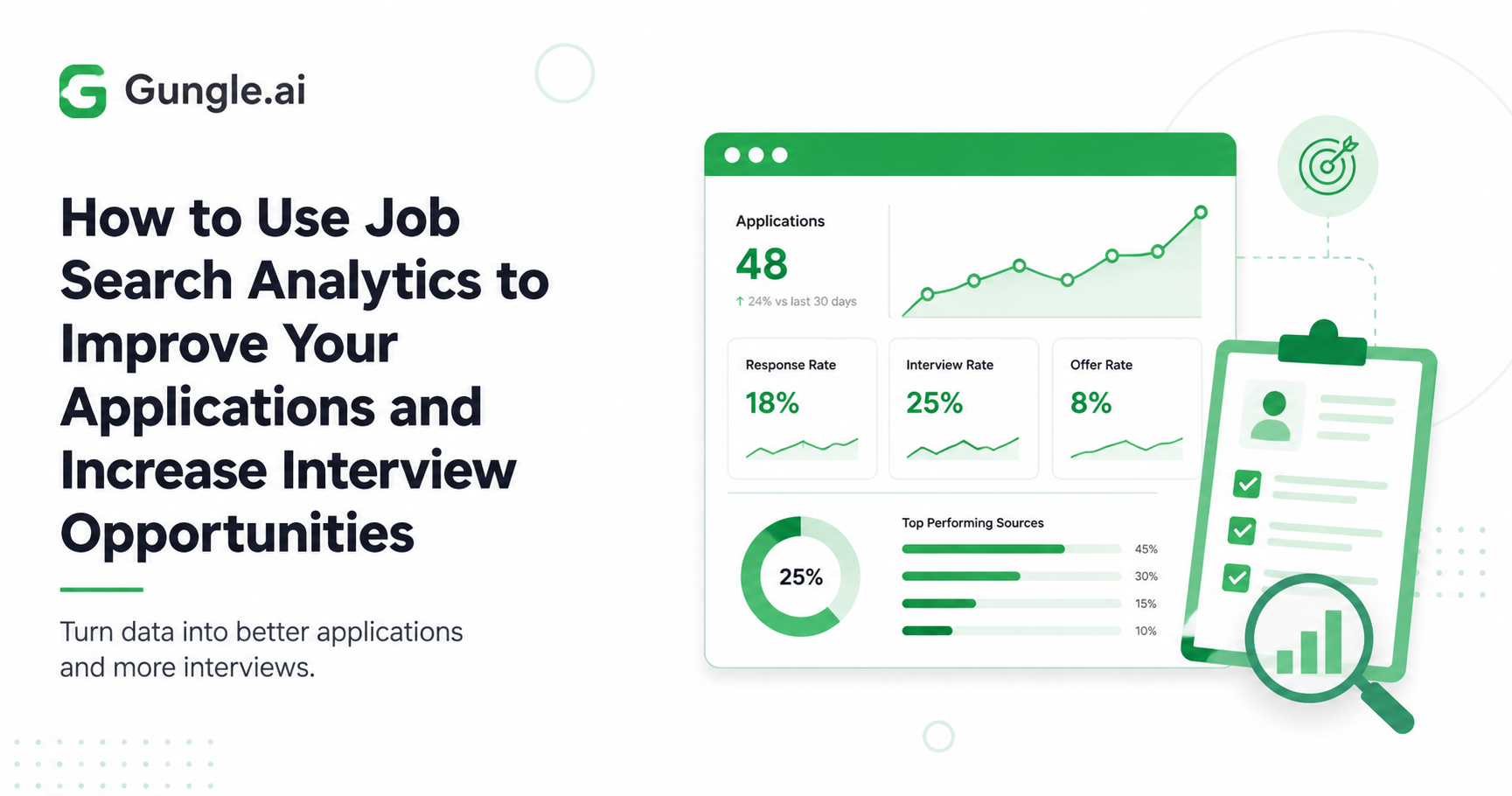
How to Use Job Search Analytics to Improve Applications and Get More Interviews
Sending more applications does not always produce better results. Job search analytics helps you understand which roles, application sources, resume versions, and strategies lead to employer responses.
By combining your own job search data with broader employment trends, you can focus on realistic opportunities, tailor applications more effectively, and make informed changes when your search stalls.
What Is Job Search Analytics?
Job search analytics is the process of collecting and reviewing information about your job search. It covers both personal performance data and external market information.
- Personal analytics: Applications, responses, interviews, offers, job sources, and resume versions.
- Job market analytics: Hiring demand, projected employment, common skills, job locations, and typical qualifications.
- Recruitment analytics: The data employers use to evaluate hiring activity, such as applicant sources, screening results, and time to fill positions.
You do not need advanced software. A spreadsheet can reveal which parts of your strategy are working.
Use Job Market Analytics to Choose Target Roles
Start by determining whether employers need the work you want to do. Authoritative resources such as the U.S. Bureau of Labor Statistics Occupational Outlook Handbook provide information about job duties, education, pay, and projected employment. The O*NET database covers occupation-specific skills, tasks, knowledge, and technology.
Combine these sources with current job postings to answer practical questions:
- Which related job titles appear frequently?
- What skills recur across multiple postings?
- Are roles concentrated in particular industries or locations?
- Which requirements are essential, and which are merely preferred?
- Do your experience and education align with typical expectations?
For example, someone searching only for “marketing specialist” might discover related titles such as content coordinator, digital marketing associate, or campaign specialist. Expanding the search creates more opportunities without changing the underlying career goal.
Remember that postings offer a partial view of demand. Listings may be duplicated, outdated, or written more broadly than the employer’s actual requirements. Validate career market insights across several sources instead of relying on one job board.
Track the Job Search Data That Matters
Create a tracker with one row for every application. Record:
- Company, title, location, and application date
- Where you found the opening
- Whether you had a referral
- Resume and cover letter version
- Important skills named in the posting
- Response, screening call, interview, rejection, or offer
- Follow-up date and notes
Review these core metrics every few weeks:
- Response rate: Employer responses divided by completed applications.
- Interview rate: Applications that produced interviews divided by completed applications.
- Interview-to-offer rate: Offers divided by interview processes completed.
- Source performance: Interviews generated by referrals, company career pages, job boards, recruiters, or networking.
- Resume performance: Results produced by each resume version.
Small samples can be misleading. One interview from two applications does not establish a reliable pattern. Look for repeated results before changing your strategy.
Turn Analytics Into Better Applications
Diagnose where the process is breaking down
If you submit many well-matched applications but receive few responses, review your targeting and resume. Make sure your document clearly shows relevant skills, results, and terminology used in the posting.
If you regularly reach interviews but do not advance, the application may not be the problem. Review your examples, research, interview answers, and questions for the employer.
Tailor evidence, not just keywords
Keywords can help communicate alignment, but copying a job description is not enough. Connect each important skill to evidence.
Instead of listing “project management,” you might describe how you coordinated a product launch, managed deadlines, or organized work across teams. Use accurate language and never add skills you do not possess.
Prioritize opportunities with a simple score
Before applying, rate each opening from one to five in these areas:
- Skills match
- Relevant experience
- Interest in the work
- Location and working arrangement
- Compensation fit, when disclosed
- Access to a referral or employer contact
Use the total to decide where to invest tailoring and networking time. This prevents attractive company names from distracting you from stronger matches.
Use Employment Trends Carefully
Employment trends can reveal growing occupations and changing skill needs, but they cannot predict whether one employer will interview you. National projections may also differ from conditions in your city or industry.
Use trend data to guide decisions, not make them automatically. If postings repeatedly request a tool you lack, investigate whether it is fundamental to the role. You may need a course or project, but not every frequently mentioned skill requires a certification.
Common Job Search Analytics Mistakes
- Tracking volume alone: Fifty poorly matched applications provide less useful insight than a focused set with clear results.
- Changing several variables at once: Test one major adjustment, such as a revised resume summary, so you can evaluate its effect.
- Ignoring job quality: A higher response rate is not valuable if the roles do not meet your needs.
- Treating correlation as proof: A referral and an interview may be connected, but limited data cannot establish the exact cause.
- Using outdated market information: Check publication dates and confirm trends against current listings.
Frequently Asked Questions
How often should I review my job search analytics?
Update your tracker after each activity and review patterns every two to four weeks. This provides enough time to gather results without allowing an ineffective strategy to continue indefinitely.
What is a good interview rate?
There is no universal benchmark. Results vary by occupation, experience level, location, hiring conditions, and application quality. Compare your performance over time and across role types rather than relying on an unsupported target.
Can analytics help career changers?
Yes. Career changers can compare job descriptions to identify transferable skills, adjacent titles, and recurring gaps. Your tracker can then show which positioning produces the strongest response.
Build a More Focused Job Search
Job search analytics turns applications into useful feedback. Track your activity, study reliable job market analytics, and make one evidence-based improvement at a time. The goal is not simply to apply more. It is to find better matches and create more opportunities for meaningful interviews.
Ready to put your career market insights into action? Explore relevant job openings on Gungle.ai and see where your skills could take you.